
Chlorine
Release Date: 2022-06-16 10:34:18 Visit: 811
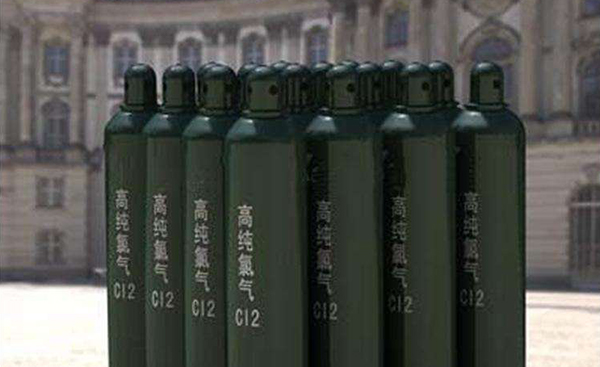
Chlorine is an elemental substance formed by chlorine, with the chemical formula Cl2. Under normal temperature and pressure, it is yellow-green, a highly toxic gas with a strong pungent odor, suffocating, and its density is higher than that of air. Melting point -101.00℃, boiling point -34.05℃. Soluble in water and alkali solution, soluble in organic solvents (such as carbon tetrachloride), insoluble in saturated brine [8] . It is easy to compress and can be liquefied into yellow-green oily liquid chlorine. It is one of the main products of the chlor-alkali industry and can be used as a strong oxidant.
When chlorine gas is mixed with hydrogen with a volume fraction of more than 5%, there may be a danger of explosion when exposed to strong light. Chlorine gas is toxic. It mainly invades the human body through the respiratory tract and dissolves in the water contained in the mucous membrane, causing damage to the mucous membrane of the upper respiratory tract. Chlorine can undergo substitution and addition reactions with organic and inorganic substances to form various chlorides. Mainly used in the production of plastics (such as PVP), synthetic fibers, dyes, pesticides, disinfectants, bleach solvents, and various chlorides.
Chlorine in nature mostly exists in the form of Cl- ions in minerals or seawater, and a small amount of chlorine exists in the atmosphere in a free state, but at this time, chlorine gas is often decomposed into two chlorine atoms (free radicals) by ultraviolet rays, and chlorine gas is also One of the main elements that destroy the ozone layer.
Application Field
Chemical Industry
The chemical industry is used for the production of inorganic chemical products such as sodium hypochlorite, aluminum chloride, ferric chloride, bleaching powder, bromine, phosphorus trichloride, etc., and also for the production of organic chlorides, such as chloroacetic acid, epichlorohydrin, monochlorinated Benzene etc. Also used in the production of neoprene, plastics and plasticizers. The daily chemical industry is used in the production of sodium alkyl sulfonate and sodium alkyl benzene sulfonate, the raw materials of synthetic detergents.
Propylene Oxide
In the process of producing propylene oxide by the chlorohydrin method, there is a one-step reaction that propylene reacts with hypochlorous acid to generate chlorohydrin, so chlorine water can be used in the chlorohydrin reaction, and at the same time, chlorine water can partially replace the process water used in production.
The reaction equation is as follows:
Cl2+H2O=HCIO+HCl;
CH3CHCH2+HCIO=CH3CHClCH2OH.
CH3CHClCH2OH+Ca(OH)2=CH3CHCH2O+CaCl2+2H2O.
Preparation of Ferric Chloride
This method utilizes industrial hydrochloric acid or pickling waste liquid to react with waste iron filings to generate ferrous chloride solution, the circulating absorption liquid composed of ferrous chloride solution and waste iron filings undergoes redox reaction with chlorine gas, and chlorine gas oxidizes Fe2+ to Fe3+ , Fe3+ is reduced to Fe2+ by iron filings in the absorption liquid, and Fe2+ continues to react with chlorine gas to form cyclic absorption.
The equations involved are:
Fe+2H+=Fe2++H2↑;
2Fe2++Cl2=2Fe3++2Cl-;
2Fe3++Fe=3Fe2+.
Hydrochloric Acid Production
When producing hydrochloric acid in industry, firstly, hydrogen is ignited in the reactor, and then chlorine gas is introduced for the reaction to obtain hydrogen chloride gas. The reaction equation is: H2+Cl2=2HCl. Hydrogen chloride gas is absorbed by water and becomes hydrochloric acid after cooling. In the reaction process of chlorine and hydrogen, toxic chlorine is surrounded by excess hydrogen, so that chlorine can be fully reacted and air pollution is prevented.
PVC
The heavy monomer method can be divided into two routes, one is the petroleum route using ethylene as the raw material, that is, the oxychlorination method. Ethylene is separated from petroleum cracking, and then Cl2 generated by the action of oxygen and HCl (by-product of cracking) undergoes a chlorination reaction with ethylene to generate dichloroethane, and then cracks out hydrogen chloride to obtain vinyl chloride.
The overall reaction equation is:
4CH2=CH2+O2+2Cl2→4CH2=CHCl+2H2O
The other is the acetylene calcium carbide method. Acetylene is prepared from calcium carbide as raw material, and then reacted with hydrogen chloride to obtain vinyl chloride.
The reaction equation is:
CaC2+2H2O→4CHCH+Ca(OH)2;
CHCH+HCl→CH2=CHCl (reaction conditions are HgCl2/C 120-180℃).
Bleach
There are many bleaches made of chlorine gas, and there are two kinds of bleaches in general life, NaClO and Ca(ClO)2. Generally speaking, the disinfectant is NaClO, which is usually prepared by passing chlorine gas into sodium hydroxide. However, its price is higher, and it is not used in industrial bleaching, which is common in 84. Disinfection powder is Ca(ClO)2, because it is not stable enough, it is generally solid. It is prepared by passing chlorine gas into lime milk. It is cheap and used for industrial bleaching. bleach. When storing the above bleach, pay attention to sealing and drying, and avoid direct sunlight. Because hypochlorite reacts with carbon dioxide and water in the air, hypochlorous acid is produced, and hypochlorous acid decomposes under light, causing the bleach to fail.
Calcium hypochlorite solid is prepared, and the product obtained by absorbing chlorine-containing tail gas with sodium hydroxide solution is sodium hypochlorite solution, and solid product cannot be obtained, and it is not easy to store for a long time. When chlorine gas is absorbed by the mixed aqueous solution of sodium hydroxide and calcium hydroxide, calcium hypochlorite solid can be obtained, which is convenient for storage and use.
Electronics Industry
In the electronics industry, high-purity chlorine gas is mainly used for dry etching, optical fiber, crystal growth and thermal oxidation in the electronics industry.
Dry Etching
Dry etching is a thin-film etching technique using plasma.
Dry etching, also known as dry etching, refers to a gas-solid reaction. The gas-phase products mainly include GaCl2, AsCl2 and hydrogen. When using chlorine gas for plasma etching, 5% high-purity chlorine gas + 95% helium gas are usually used.
Preparation of Nanocrystalline Cellulose by Oxidative Degradation of Chlorine Gas
The Chinese patent discloses a method for preparing nano-microcrystalline cellulose by chlorine oxidative degradation. Compared with the preparation of nano-crystalline cellulose by hydrolysis, the chlorine oxidative degradation method utilizes the bleaching effect of sodium hypochlorite produced by chlorine hydrolysis, which can make the prepared Nanocrystalline cellulose is bright and white.
Chlorine is also used in large-scale integrated circuits, optical fibers, high-temperature superconductivity and other technical fields.
Other Aspects
Sewage Treatment For Breweries
Chinese patent discloses method of treating brewery sewage with chlorine gas. Chlorine has low price, low dosage, reliable disinfection and mature technology. It is a disinfectant commonly used by water companies. Chlorine can also deodorize and remove microorganisms, and has a high removal rate of biological oxygen consumption and chemical oxygen consumption, which can ensure The recycled water quality is stable, so it is more suitable for the treatment of brewery sewage.
Disinfection of Tap Water
Tap water is often disinfected with chlorine gas. About 0.002 g of chlorine gas is passed into 1 L of water. The principle of disinfection is that it reacts with water to generate hypochlorous acid, and its strong oxidizing properties kill germs in the water. The reason why hypochlorous acid is not directly used for sterilization and disinfection of tap water is because hypochlorous acid is easy to decompose, difficult to preserve, has high cost, and is highly toxic. Using chlorine gas for disinfection can balance the dissolution, decomposition and synthesis of hypochlorous acid in water. Appropriate concentration, less residual toxicity in water.
Removal of sulfur and phosphorus impurities in acetylene
Acetylene gas is the main raw material for PVC production. In industrial acetylene gas, sulfur and phosphorus exist in the form of H2S and H3P gases. These two gases exceed the standard and will poison the catalyst used in the production of PVC.
Using the strong oxidizing property of CIO- in chlorinated water, spray washing of acetylene gas can remove H2S and H3P.
The reaction equation is as follows:
4ClO-+H2S→H2SO4+4Cl-
4ClO-+H3P→H3PO4+4Cl-.
Chlorine in the pharmaceutical industry is often used in pharmaceuticals and is often involved in the synthesis of chlorine-containing compounds. Such as: amlodipine maleate tablets; N-(2-methyl-2,3-dihydro-1H-indolyl)-3-sulfamoyl-4-chloro-benzamide.
The pesticide industry is used as a raw material for the production of high-efficiency insecticides, fungicides, herbicides, and plant growth stimulators.
The metallurgical industry is mainly used for the production of metals such as titanium and magnesium.
Storage and Transportation
Due to the rapid oxidation or decomposition of substances, the phenomenon of increasing temperature, pressure or both at the same time is called explosion. When an explosion occurs, the potential energy (chemical energy or mechanical energy) is suddenly converted into kinetic energy, and high-pressure gas is generated or released. Explosion is divided into physical explosion, chemical explosion and nuclear explosion. Physical explosion is an explosion caused by the rapid expansion of liquid into steam or gas, the pressure increases rapidly, and greatly exceeds the limit pressure of the container; chemical explosion is caused by the chemical reaction of the substance itself , an explosion that produces a large amount of gas and high temperature. The explosion in the process of chlorine production, storage and transportation has both physical and chemical explosion possibilities.
Liquid chlorine is prone to the following problems during production, storage and transportation:
①The mixture of chlorine, hydrogen and air in the liquefied exhaust gas exploded;
②The residual organic impurities in the packaging container react and explode with chlorine gas;
③ The ammonium salt in the water and salt solution is brought into the liquefaction system, which will cause the accumulation of nitrogen trichloride in the liquid chlorine and cause an explosion.
When the liquid chlorine is evaporated and used up, all the containers used must be rinsed with water and alkaline water to remove the liquid chlorine polluted by nitrogen trichloride before repair and use. Chlorine is a highly toxic substance, and equipment such as pressurized containers should be strictly required in production to prevent chlorine gas leakage. The allowable concentration of chlorine in the air is not more than 1ppm.
Chlorine liquefaction
Chlorine gas can usually be used directly, but in order to prepare pure chlorine gas, and considering the convenience of storage and transportation, a part of chlorine gas is liquefied into liquid chlorine, which is transported to users by steel cylinders or tankers. In production, the hot chlorine gas (which contains a small amount of impurities such as hydrogen, oxygen and carbon dioxide) from the electrolytic cell is washed with cold water or condensed and dehydrated in a heat exchanger, and then dried with sulfuric acid (if necessary, it can be washed with liquid chlorine to remove moisture) and impurities), and then sent to liquefaction. Because wet chlorine has a corrosive effect on iron, the moisture in chlorine should be less than 50 ppm before liquefaction.
Common methods of chlorine liquefaction are: (1) low temperature method; (2) direct compression method or high pressure method; (3) low temperature compression method or comprehensive method.
The temperature and pressure range of chlorine gas liquefaction is very large, and industrial production is divided into low pressure method, medium pressure method and high pressure method. In the low-pressure method, the chlorine gas is 0.078 to 0.147 MPa (gauge pressure) and the cooling temperature is -35 to -40 °C for liquefaction. In the medium pressure method, the liquefaction is carried out at a chlorine gas of 0.245 to 0.49 MPa and a cooling temperature of -15 to -20 °C. The chlorine gas of the high pressure method is 0.98-1.17 MPa, and it can be liquefied by cooling with water at 15-25°C. Compared with the low pressure method, the high pressure method has lower energy consumption and less circulating water consumption, but the equipment cost is higher, which is suitable for large-scale production and use. The medium and small chlor-alkali plants mostly use the medium pressure method.
The liquefaction rate is determined by the hydrogen content in the chlorine. The hydrogen content in the liquefied tail gas shall not exceed 4% (volume). The tail gas contains 60%-70% chlorine gas, which can be used as the raw material gas for the synthesis of hydrochloric acid, chlorobenzene and hypochlorite, and can also be purified by deep purification, so that the liquefaction rate can reach 98%-99%.